
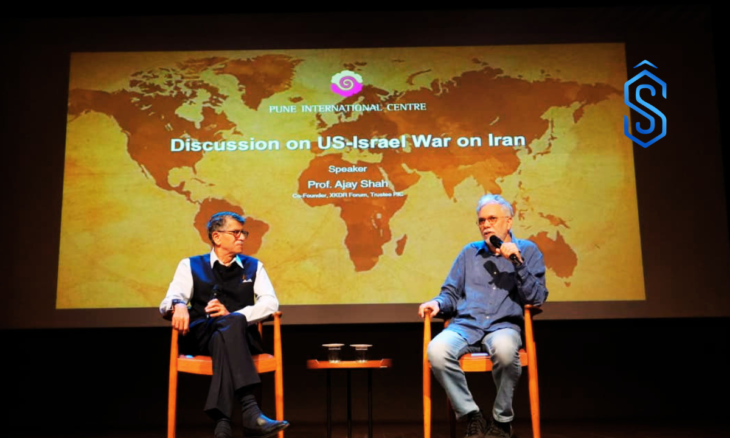
Pune: The Centre for National Security Studies (CNSS), under the aegis of the Pune International Centre (PIC), convened a high-level discussion on “US–Israel War on Iran,” spotlighting evolving global conflict dynamics and India’s strategic positioning.
The session, organised by the Centre for National Security Studies, featured Ajay Shah, Co-founder of XKDR Forum and Trustee of PIC.
The dialogue hosted by the Centre for National Security Studies examined modern warfare, intelligence battles, and geopolitical implications for India amid rising tensions in West Asia.
Lt Gen Vinayak Patankar, Convenor of the Centre for National Security Studies, set the tone by introducing Prof. Shah as an economist with deep expertise in military technology and strategic affairs.
War Beyond Simplistic Narratives
In his presentation, Prof. Ajay Shah described the ongoing conflict as a deeply emotive subject, cautioning against oversimplified, “Bollywood-style” interpretations.
“War isn’t the simplistic Bollywood-style narratives; it is cold reality,” he stated, urging audiences to adopt a rational and analytical approach.
The session emphasised that contemporary warfare has evolved significantly, driven by surveillance technologies such as drones and satellites, alongside precision-guided munitions.
Prof. Shah noted that secrecy in military operations is becoming increasingly difficult in this new paradigm.
Also Read: Hormuz Impact on Mumbai Real Estate: Why South Mumbai Homes Will Get Costlier
Modern Warfare and Intelligence Dominance
The discussion highlighted the growing role of intelligence warfare, particularly the integration of artificial intelligence in identifying and tracking targets.
Prof. Shah pointed out that democracies often possess superior intelligence capabilities compared to authoritarian regimes due to internal dissent that can lead to information leaks. He added that India must remain aware of what intelligence other nations are gathering about it.
He further remarked that the global landscape is marked by uncertainty: “We are in a world of chaos, and war.”
He also raised concerns about how the administration of Donald Trump might respond to potential geopolitical flashpoints such as a Chinese invasion of Taiwan.
Centre for National Security Studies: Global Politics and Strategic Trade-offs
The forum also explored the complexities of international relations. Prof. Shah noted that modern geopolitics is driven by national interests rather than ideological commitments, often requiring difficult trade-offs involving sovereignty.
He underscored that the interests of governments and their citizens may not always align, adding another layer of complexity to global decision-making.
Iran: State vs People
Focusing on Iran, the Centre for National Security Studies discussion drew a distinction between the Iranian state and its people. Prof. Shah observed that Iranian citizens have borne significant economic and social costs due to the regime’s strategic decisions, including heavy military expenditure under sanctions and mismanagement of oil resources.
He described Iranians as culturally sophisticated, noting that segments of the population harbour resentment toward the regime.
US–Iran Military Dynamics
The Centre for National Security Studies session also examined evolving military dynamics in the conflict. Prof. Shah highlighted the dominance of the United States in air operations, citing recent missions in Iran, including pilot rescue efforts and low-altitude flights by vulnerable aircraft.
He stated that claims of Iran having an upper hand are only partially accurate, given the stark economic disparity between the United States and sanctions-hit Iran.
India’s Strategic Position
A key takeaway from the discussion was India’s unique geopolitical positioning. Prof. Shah suggested that India is in a distinctive position to potentially contribute to resolving tensions involving Iran, given its diplomatic relationships and strategic autonomy.