
New Delhi: Indian exporters, particularly Micro and Small Enterprises, will be eligible for higher travel reimbursements, a wider range of certification assistance and expanded freight support under revised Niryat Disha guidelines announced by the Department of Commerce.
The changes cover three major areas of export facilitation: participation in international trade events, compliance with overseas quality and safety standards, and transportation of export consignments.
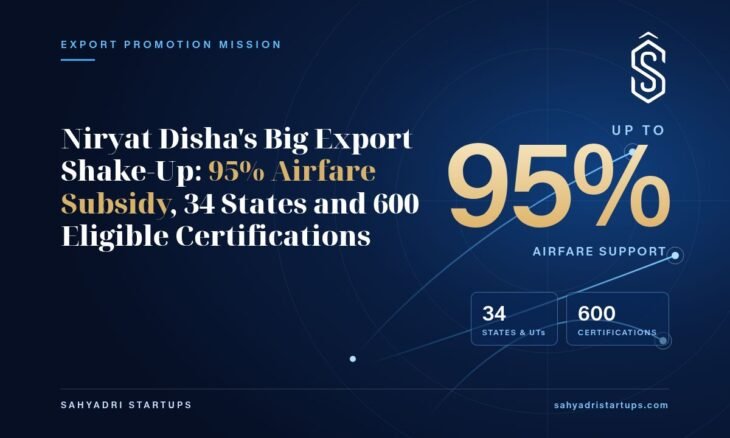
Among the biggest changes, airfare reimbursement for Micro and Small Exporters has been increased to up to 95%, the list of eligible certificates has expanded from 462 to 600, and logistics assistance now covers low export-intensity districts across 34 States and Union Territories, compared with 13 earlier.
The amendments cover interventions under Niryat Disha, the market access and non-financial export support component of the government’s ₹25,060 crore Export Promotion Mission (EPM).
Niryat Disha Raises Airfare Reimbursement to 95% for Smaller Exporters
The revised Market Access Support (MAS) guidelines increase the financial assistance available to exporters participating in Buyer-Seller Meets (BSMs), Reverse Buyer-Seller Meets (RBSMs), international trade fairs, exhibitions and trade delegations.
Micro and Small Exporters can now claim airfare reimbursement of up to 95%, while other eligible exporters will receive reimbursement of up to 80%.
The eligibility threshold has also been revised significantly. The maximum eligible export turnover for claiming airfare reimbursement has increased from ₹75 lakh in the preceding year to ₹50 crore.
Additionally, exporters will no longer need to maintain six months of membership with Export Promotion Councils to access the assistance. The mandatory membership period has been reduced to three months.
These changes expand the eligibility framework for exporters seeking financial assistance to participate in international market access activities.
Eligible Export Certifications Expanded From 462 to 600
The government has also widened the scope of certification assistance available under the Trade Regulations, Accreditation & Compliance Enablement (TRACE) intervention.
The number of certificates eligible for reimbursement has increased from 462 to 600. The intervention supports MSMEs in meeting internationally recognised quality, safety and technical standards required in overseas markets.
The assistance covers quality and compliance-related certifications, along with mandatory and voluntary conformity-assessment requirements.
The expanded certificate list is intended to provide MSMEs with broader support in meeting regulatory and technical requirements across international markets.
Freight Support Expanded to 34 States and UTs
The most extensive set of changes concerns Logistics Interventions for Freight and Transport (LIFT), which provides assistance to MSMEs facing higher transportation costs because of geographical disadvantages and inadequate logistics connectivity.
The revised guidelines expand the coverage of low export-intensity districts from 13 States and Union Territories to 34, significantly widening the geographical reach of the intervention.
The government has also broadened the definition of eligible logistics infrastructure and transportation routes.
Land Customs Stations (LCSs) and Integrated Check Posts (ICPs) have been added to the existing categories of eligible ports, while waterways have been included alongside road, rail and air transport.
Air freight support for export shipments, previously available in the North Eastern Region, has also been extended to Jammu & Kashmir and Ladakh.
Another important change is the reduction in the minimum distance eligibility requirement between origin and destination ports from 200 km to 100 km.
Further, the freight assistance will now cover all exportable merchandise items, except products and export categories included in the specified negative list.
Together, these changes expand the geographical reach, transportation options and product coverage of logistics assistance available to MSMEs under Niryat Disha.
Export Promotion Mission: ₹25,060 Crore to Strengthen India’s Export Competitiveness
The latest amendments are part of the broader Export Promotion Mission, which received Union Cabinet approval on 12 November 2025 with an outlay of ₹25,060 crore for FY 2025-26 to FY 2030-31.
The Mission is designed to strengthen India’s export competitiveness through targeted financial and non-financial assistance, with a focus on MSMEs, first-time exporters and under-represented regions.
It operates through two sub-schemes: Niryat Protsahan, which facilitates access to trade finance, and Niryat Disha, which addresses market access and other non-financial barriers to exports.
A total of 11 interventions under the two sub-schemes have been operationalised so far.