
New Delhi: Scientists at the International Advanced Research Centre for Powder Metallurgy and New Materials (ARCI), Hyderabad, have developed advanced protective coatings that can significantly improve the durability of cutting tools used in the machining of super alloys.
The development could benefit the aerospace, energy and petrochemical sectors, where nickel-based superalloys are essential for manufacturing components that operate under extreme conditions.
The machining of super alloys used in aircraft engines, power plants and petrochemical systems presents a major manufacturing challenge.
Nickel-based superalloys such as Inconel 718 (IN718), IN625 and IN617 possess exceptional strength and hardness, making them difficult to cut and shape.
Their rapid work hardening, poor thermal conductivity and strong chemical interactions with cutting tools accelerate tool wear, reduce productivity and increase manufacturing costs.
To address these challenges, scientists from ARCI, Hyderabad, an autonomous research and development centre of the Department of Science and Technology (DST), have developed and evaluated two nanocomposite protective coatings: Titanium Aluminium Silicon Nitride (TiAlSiN) and Chromium Aluminium Silicon Nitride (CrAlSiN).
The coatings were deposited in-house using cathodic-arc Physical Vapour Deposition (PVD) on widely used tungsten carbide cutting tools.
The researchers subsequently evaluated their performance during the milling of three nickel-based superalloys: IN718, IN625 and IN617.
The study examined improvements in tool life and investigated the mechanisms governing the performance of the protective coatings during the machining of super alloys.
ARCI Study Finds Different Coatings Perform Better for Different Superalloys
One of the important findings of the research is that no single protective coating delivers the best performance across all superalloys.
The effectiveness of a coating depends significantly on the chemical composition of the material being machined and its interaction with the coating.
The study found that TiAlSiN-coated cutting tools delivered significant improvements in tool life while machining IN718 and IN625.
For IN718, the TiAlSiN-coated tool improved tool life by approximately 80% compared with an uncoated tool. During the machining of IN625, the improvement in tool life was approximately 60%.
However, the results were considerably different for IN617. In this case, CrAlSiN demonstrated superior performance, increasing cutting tool life by more than 200%.
These findings indicate that TiAlSiN may be better suited for machining IN718 and IN625, while CrAlSiN offers substantially better performance for IN617.
The research provides a scientific basis for selecting protective coatings according to the specific superalloy being machined, rather than relying on a single coating for different materials.
Researchers Identify Major Causes of Cutting Tool Failure
Along with evaluating improvements in tool life, the researchers investigated the mechanisms responsible for cutting tool failure during the machining of nickel-based superalloys.
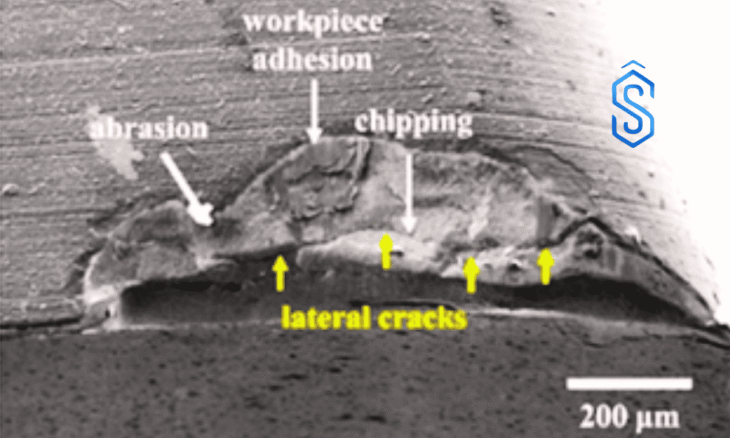
The study identified repeated adhesion of workpiece material to the cutting tool surface as a major cause of damage.
During machining, a layer of the superalloy can adhere to the cutting edge. When this material subsequently breaks away, it can pull tiny fragments from the tool surface, progressively resulting in chipping.
The protective coatings helped delay this damage and extend cutting tool life.
The researchers identified chipping and progressive wear as the major failure modes. Abrasion, adhesion and attrition were also found to contribute to the overall wear process.
Understanding these mechanisms is important for improving the machining of super alloys, as cutting tools are exposed to demanding thermal and mechanical conditions while processing these high-strength materials.
Study Examines Chip Formation During Superalloy Machining
The researchers also investigated the metal chips generated during the machining process to understand the behaviour of nickel-based superalloys under cutting conditions.
The chips exhibited characteristic shear bands and serrated or saw-tooth patterns, reflecting the intense thermo-mechanical conditions experienced during machining.
The degree of chip segmentation was found to be related to tool performance. These observations provided further insights into the complex machining behaviour of advanced nickel-based superalloys.
The findings add to the understanding of how material properties, cutting conditions and protective coatings influence the machining of super alloys.
Advanced Coatings Could Reduce Manufacturing Costs
Longer-lasting cutting tools can help manufacturers reduce machine downtime, improve productivity and lower the cost of machining high-value engineering components.
This is particularly relevant for the aerospace, energy and petrochemical industries, where nickel-based superalloys are indispensable for components that must withstand extreme operating conditions.
More significantly, the research highlights the importance of adopting a science-based, application-specific approach to protective coatings.
Instead of searching for a universally superior coating, manufacturers can select or develop coatings based on the composition and behaviour of the particular alloy being machined.
Such an approach could contribute to more efficient, reliable and cost-effective manufacturing of components made from advanced materials.
ARCI Research Published in Materials Today Communications
The research was carried out at ARCI’s Centre for Engineered Coatings and has been published in the journal Materials Today Communications.
The study demonstrates that improving the machining of some of the industry’s most demanding materials requires more than simply developing a better protective coating. Matching the right coating to the right material is equally important.
Link to Publication: Research Paper – Materials Today Communications https://doi.org/10.1016/j.mtcomm.2024.109101