
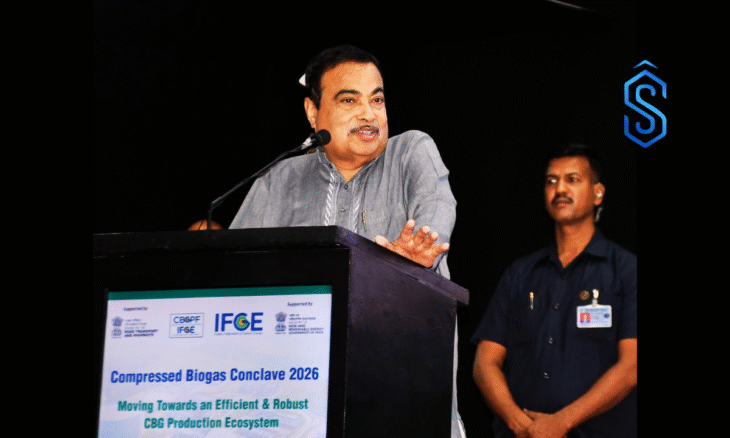
Pune: Union Minister for Road Transport and Highways Nitin Gadkari inaugurated the Compressed Biogas Conclave 2026 at Yashwantrao Chavan Academy of Development Administration (YASHADA) in Pune, underscoring the importance of energy security and the need to accelerate the adoption of alternative fuels to build a sustainable transport ecosystem.
The two-day Compressed Biogas Conclave 2026 has been organised by the Indian Federation of Green Energy (IFGE) under the theme “Moving Towards an Efficient & Robust CBG Production Ecosystem.”
The event brought together policymakers, industry leaders, researchers, and stakeholders to discuss the future of compressed biogas and its role in strengthening India’s clean energy transition.
Addressing the gathering at the Compressed Biogas Conclave 2026, Gadkari stressed that energy security has become a critical national priority, particularly in the context of evolving global geopolitical tensions and ongoing international conflicts.
“India currently imports nearly 86% of its energy requirements, resulting in an annual outflow of approximately ₹22,00,000 crore,” he said. “Given the uncertain global environment and ongoing international conflicts, strengthening energy security has become extremely important.”
He reiterated the government’s long-term vision to transform India’s mobility ecosystem. “Our vision is to make India’s transport ecosystem smart, safe, and sustainable by 2030,” Gadkari said during his address at the Compressed Biogas Conclave 2026.
Also Read: Renewable Energy Powered AI Data Centres: Adani Group Commits $100 Billion Investment by 2035
Push for Green and Indigenous Fuels
Highlighting the role of green energy solutions, Gadkari said promoting non-polluting and indigenous fuels has been a key policy focus of the government. According to him, such fuels not only reduce environmental impact but also strengthen the agricultural economy.
At the Compressed Biogas Conclave 2026, he outlined the government’s efforts to promote alternative fuels and biofuels, including ethanol, methanol, biodiesel, bio-CNG, electric mobility, and hydrogen.
He noted that the government has adopted a market-based and need-based approach to encourage adoption and industry participation in the alternative fuel ecosystem.
Recalling the early phase of electric mobility in India, Gadkari shared an anecdote highlighting the skepticism that existed when electric vehicles were first introduced.
“People used to ask me whether I would come and push the vehicle if it stopped in the middle of the road,” he said humorously, noting that technological advancements have since addressed such concerns.
Massive Market Opportunity for Biofuels
During his address at the Compressed Biogas Conclave 2026, Gadkari emphasized that India offers enormous market potential for biofuels and alternative fuels.
He said the success of any industry depends on four critical factors — technology, economic viability, availability of raw materials, and effective marketing of the finished product.
“As far as the finished product is concerned, there will be no shortage of demand. Whatever you produce will find a market,” he said.
However, he stressed that the sector must develop an integrated ecosystem by improving quality, increasing production capacity, adopting advanced technologies, and reducing capital costs.
Also Read: SERC InSolare MoU Signed for Testing and Validation of Renewable Energy Systems
Role of Biotechnology in Biomass Productivity
Highlighting the importance of scientific innovation, Gadkari said biotechnology could significantly enhance the productivity of biomass used for fuel production.
Speaking at the Compressed Biogas Conclave 2026, he explained that improved biomass productivity would allow the same quantity of raw material to generate higher gas output, thereby improving efficiency and economic viability in biofuel production.
He acknowledged that economic viability remains a concern when fuels are based on agricultural inputs but noted that alternative fuels are already competitive at current petrol and diesel prices.
Ethanol-Based Mobility as a Practical Example
Sharing a personal example during the Compressed Biogas Conclave 2026, Gadkari said he currently uses a Toyota Innova that runs entirely on ethanol while generating around 60% electricity.
“When I calculate the combined cost of ethanol and electricity, the effective fuel cost comes to around ₹32–₹35 per litre equivalent of petrol mileage,” he said.
He described the system as an import substitute that is cost-effective, pollution-free, and based on indigenous resources.
Gadkari also revealed that representatives from Toyota Motor Corporation recently informed him about plans to launch a new flex-engine version of the Innova. The vehicle, which already operates significantly on electricity, is also being developed with electric charging capabilities.
According to him, the success of such innovations demonstrates that dual-fuel systems can be implemented effectively.
Innovation and Value Addition Crucial for Growth
At the Compressed Biogas Conclave 2026, Gadkari stressed that innovation, entrepreneurship, science, technology, research, and skill development will play a decisive role in transforming knowledge into economic value.
He highlighted that future growth in the alternative fuel sector will depend on value-added products, cost-effective technologies, and efficient utilization of by-products.
“The more value addition we create and the more cost-effective technologies we develop, the more economically viable the industry will become,” he said, calling for a fully integrated development approach across the ecosystem.
Also Read: New Photo-Rechargeable Supercapacitor Combines Solar Capture and Energy Storage in One Device
Bio-Bitumen Road Experiment
Gadkari also spoke about innovations in infrastructure development. He revealed that a one-kilometre road stretch constructed using bio-bitumen was recently built on the Nagpur–Jabalpur highway following research conducted by the Central Road Research Institute.
The technology was patented and later showcased at an industry event held at Dr. Ambedkar Hall in Delhi. Gadkari said initial doubts existed regarding whether companies would adopt the technology.
However, he noted that 15 companies eventually acquired the patent, reflecting growing industry interest in sustainable infrastructure solutions.
He added that oil companies have now been encouraged to develop a new refinery mix containing:
- 30% bio-bitumen
- 16% powder from used rubber tyres
- 7% plastic
Such innovations could significantly reduce waste while creating more sustainable road construction materials.
Challenges in Implementing New Technologies
Acknowledging the difficulties associated with implementing new technologies, Gadkari said policy implementation often comes with challenges.
“Even as a minister, I personally experience the difficulties involved in implementing new technologies,” he said at the Compressed Biogas Conclave 2026.
Despite these challenges, he emphasized the need to continue building a sustainable and self-reliant energy ecosystem for India through innovation, research, and strong industry collaboration.
Compressed Biogas Conclave 2026: Dignitaries and Strategic Collaboration
The inaugural ceremony of the Compressed Biogas Conclave 2026 was attended by several dignitaries including T. Krishna Prasad, Annasaheb M. K. Patil, Y. B. Ramakrishna, and Sanjay Ganjoo.
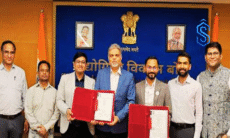
A key highlight of the event was the signing of a Memorandum of Understanding (MoU) between:
- ICAR-Indian Institute of Millets Research
- Vasantdada Sugar Institute
- Indian Federation of Green Energy
The MoU aims to strengthen collaboration in bioenergy development and the sustainable utilization of agricultural resources.