
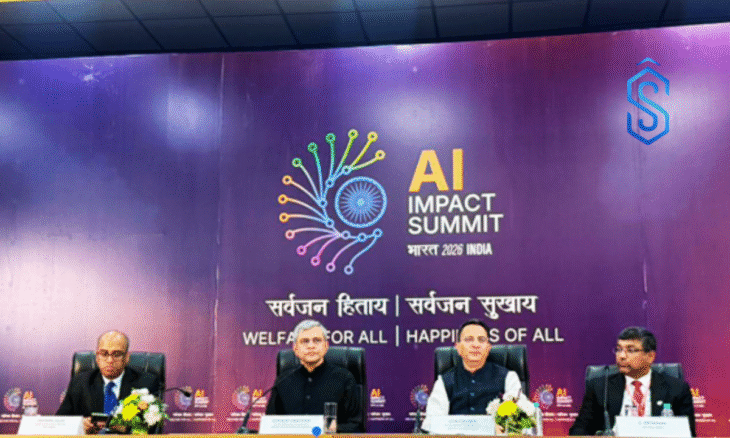
New Delhi: India AI infrastructure expansion plans received a major boost as Union Minister for Electronics and Information Technology Ashwini Vaishnaw announced the addition of 20,000 GPUs to the country’s existing compute capacity of 38,000 GPUs during the second day of the India AI Impact Summit 2026 in New Delhi.
The announcement marks the next phase of the India AI infrastructure expansion, focusing on scaling compute resources while ensuring responsible AI deployment across sectors such as healthcare and education.
Addressing the media, the Minister emphasized that the government’s approach prioritizes inclusive access to AI technologies so that innovation benefits society at large.
Vaishnaw stated that India’s AI strategy reflects the vision of Prime Minister Narendra Modi to democratize technology.
He noted that unlike many countries where AI infrastructure remains concentrated within a few corporations, India has enabled broad access to AI compute resources for researchers, startups, and institutions as part of the India AI Infrastructure Expansion roadmap.
Also Read: Ministry of Steel Invites AI Startups for Steel Industry Innovation
The media interaction was attended by Minister of State Jitin Prasada, Secretary of the Ministry of Electronics and Information Technology S Krishnan, and Abhishek Singh, CEO of the IndiaAI Mission.
The summit, being held from February 16–20, has brought together global technology leaders, policymakers, researchers, startups, multilateral institutions, and students, highlighting India’s growing role in the global AI ecosystem.
According to the Minister, strong participation from global AI leaders reflects confidence in the country’s India AI infrastructure expansion initiatives.
India AI Infrastructure Expansion: Powering $200 Billion AI Investment Wave
Speaking about investment opportunities, Vaishnaw said that over the next two years, more than $200 billion in investments are expected across AI technologies.
Venture capital firms are committing funds to deep-tech startups across all five layers of the AI stack, supporting large-scale applications and innovation aligned with the India AI infrastructure expansion strategy.
The Minister highlighted that India’s IT industry remains one of the country’s biggest strengths and emphasized coordinated efforts between industry, academia, and government to manage technological transitions.
He noted that workforce development initiatives are progressing simultaneously through reskilling and upskilling programs, creation of new talent pipelines, and curriculum updates for future technologies.
He also referenced collaboration between the Ministry of Education and the All India Council for Technical Education to revise academic curricula to prepare students for AI-driven careers, further strengthening the India AI infrastructure expansion vision.
On sovereign AI capabilities, the Minister said several AI models launched during the summit have been benchmarked against global systems and performed strongly across evaluation parameters.
He added that Stanford University has ranked India among the world’s top three AI nations, reinforcing confidence in the country’s innovation ecosystem and the broader India AI infrastructure expansion strategy.
Addressing AI safety concerns, Vaishnaw emphasized the need for a techno-legal framework combining technological safeguards with regulatory measures.
India’s AI Safety Institute, working with academic institutions, is developing technical solutions to prevent misuse while enabling innovation under the India AI Infrastructure Expansion framework.
The Minister described artificial intelligence as a driver of the fifth industrial revolution, with applications across healthcare, education, and other sectors.
Also Read: AI-Preneurs of India Showcases 45 Startups Driving Responsible AI Innovation
Demonstrations at the summit showcased healthcare solutions aimed at affordability and education technologies designed for personalized learning experiences, aligning with the goals of India AI Infrastructure Expansion.
On semiconductor development, Vaishnaw reaffirmed the government’s commitment to the Semiconductor Mission, noting that design innovation will be the primary focus in Semiconductor 2.0.
He projected that at least 50 deep-tech startups could emerge in the coming years as India strengthens its AI ecosystem through continued India AI infrastructure expansion.
Highlighting sustainability, the Minister noted that more than 50 percent of India’s power generation capacity comes from clean energy sources, currently about 51 percent.
Investments in clean energy to power AI data centres and research to reduce power and water consumption could reduce AI infrastructure energy usage by up to 35 percent, supporting sustainable India AI infrastructure expansion.
He also mentioned that more than 2.5 lakh students took a pledge on the first day of the summit to use AI responsibly, an initiative being submitted for recognition by Guinness World Records.
Concluding his address, Vaishnaw reiterated that India remains committed to advancing AI responsibly, encouraging innovation, and ensuring that AI technologies are widely deployed across sectors through continued India AI Infrastructure Expansion.