
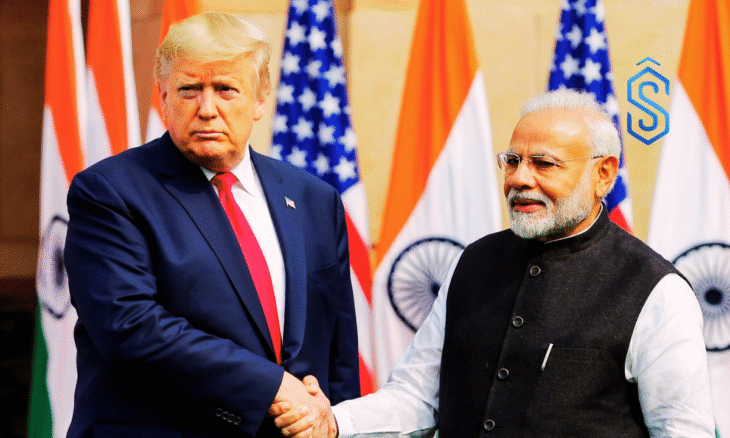
New Delhi: The India US Interim Trade Agreement framework has been announced jointly by the United States of America and India, marking a major step toward strengthening bilateral trade cooperation.
The India US interim trade agreement framework reaffirms both countries’ commitment to the broader U.S.–India Bilateral Trade Agreement (BTA) negotiations launched by President Donald J Trump and Prime Minister Narendra Modi on February 13, 2025, aimed at expanding market access commitments and strengthening resilient supply chains.
The India US interim trade agreement between the United States and India is described as a historic milestone in the partnership between the two countries, reflecting a shared commitment to reciprocal and balanced trade based on mutual interests and concrete outcomes.
Also Read: India GCC Free Trade Agreement Negotiations Launched with Terms of Reference Signing
India US Interim Trade Agreement: Key Trade and Market Access Commitments
Under the framework of the Interim Agreement:
- India will eliminate or reduce tariffs on all U.S. industrial goods and a wide range of U.S. food and agricultural products,
- including dried distillers’ grains (DDGs), red sorghum for animal feed, tree nuts, fresh and processed fruit, soybean oil, wine and spirits, and additional products.
- The United States will apply a reciprocal tariff rate of 18 percent under Executive Order 14257 of April 2, 2025 on originating goods of India, including textile and apparel, leather and footwear, plastic and rubber, organic chemicals, home décor, artisanal products, and certain machinery.
- Subject to the successful conclusion of the Interim Agreement, the United States will remove the reciprocal tariff on a wide range of goods identified in the Potential Tariff Adjustments for Aligned Partners Annex to Executive Order 14346 of September 5, 2025,
- including generic pharmaceuticals, gems and diamonds, and aircraft parts.
- The United States will also remove tariffs on certain aircraft and aircraft parts of India imposed under Proclamation 9704 of March 8, 2018; Proclamation 9705 of March 8, 2018; and Proclamation 10962 of July 30, 2025.
- India will receive a preferential tariff rate quota for automotive parts subject to Proclamation 9888 of May 17, 2019. Contingent on the findings of the U.S. Section 232 investigation of pharmaceuticals and pharmaceutical ingredients, India will receive negotiated outcomes with respect to generic pharmaceuticals and ingredients.
Also Read: Electronic Signatures and Seals: India-EU Pact Aims to Simplify Cross-Border Digital Trade
Both countries committed to providing preferential market access in sectors of respective interest and establishing rules of origin to ensure the benefits of the Agreement accrue predominantly to the United States and India.
The two countries also agreed to address non-tariff barriers affecting bilateral trade.
- India agreed to address barriers to trade in U.S. medical devices, eliminate restrictive import licensing procedures affecting U.S. Information and Communication Technology (ICT) goods, and determine within six months whether U.S.-developed or international standards are acceptable for identified sectors.
India also agreed to address long-standing non-tariff barriers affecting U.S. food and agricultural products.
To enhance regulatory compliance, both countries intend to discuss standards and conformity assessment procedures in mutually agreed sectors.
The India US interim trade agreement framework also allows either country to modify commitments if agreed tariff structures change.
The United States and India will continue negotiations toward expanding market access through the Bilateral Trade Agreement (BTA).
India US Interim Trade Agreement: Strengthening Economic Security Alignment
The United States affirmed it intends to consider India’s request to lower tariffs on Indian goods during BTA negotiations.
Both countries also agreed to strengthen economic security alignment, supply-chain resilience, and cooperation on investment reviews, export controls, and addressing non-market policies of third parties.
India intends to purchase $500 billion of U.S. energy products, aircraft and aircraft parts, precious metals, technology products, and coking coal over the next five years.
The two countries will also significantly increase trade in technology products, including Graphics Processing Units (GPUs) and goods used in data centers, while expanding joint technology cooperation.
Additionally, both countries committed to addressing barriers to digital trade and working toward mutually beneficial digital trade rules as part of the BTA.
The India US interim trade agreement framework will be implemented promptly while both nations work toward finalizing the Interim Agreement and concluding a mutually beneficial Bilateral Trade Agreement.
India US Interim Trade Agreement: Prime Minister Modi Welcomes Framework
Prime Minister Narendra Modi welcomed the India US interim trade agreement framework for the Interim Trade Agreement between India and the United States, calling it positive news for both nations.
Responding to the X post of Union Minister of Commerce and Industry Piyush Goyal, the Prime Minister wrote:
“Great news for India and USA!
We have agreed on a framework for an Interim Trade Agreement between our two great nations. I thank President Trump for his personal commitment to robust ties between our countries.
This framework reflects the growing depth, trust and dynamism of our partnership. It strengthens ‘Make in India’ by opening new opportunities for India’s hardworking farmers, entrepreneurs, MSMEs, StartUp innovators, fishermen and more. It will generate large-scale employment for women and youngsters.
India and the United States share a commitment to promoting innovation and this framework will further deepen investment and technology partnerships between us.
This framework will also strengthen resilient and trusted supply chains and contribute to global growth. As India moves forward towards building a Viksit Bharat, we remain committed to building global partnerships that are future-oriented, empower our people and contribute to shared prosperity.