
Pune: High Energy Materials Research Laboratory (HEMRL), a premier laboratory of the Defence Research and Development Organisation (DRDO), Pune, conducted a one-day short-term course titled “Modelling of Next Generation High Explosives” (NeXT-2026) on January 8, 2026.
The NeXT-2026 programme was designed as a focused academic–industrial interface to deliberate on emerging paradigms in the computational modelling and design of advanced high-energy materials.
NeXT-2026 Brings Academia, Industry and Research Institutions Together
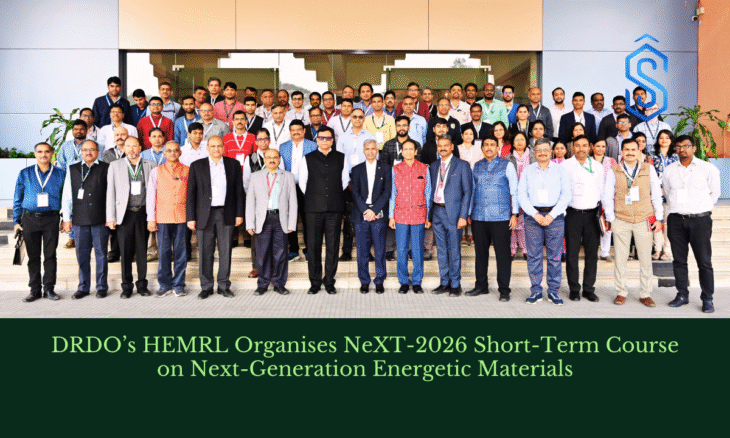
The NeXT-2026 course witnessed participation from around 150 delegates representing academia, industry, and leading research establishments, including DRDO, ISRO, and IITs.
The programme aimed to foster collaborative dialogue on cutting-edge approaches in modelling, simulation, and design of next-generation energetic materials, including explosives and allied systems.
Also Read: Scramjet Engine Breakthrough: DRDO Completes Long-Duration Hypersonic Ground Test
NeXT-2026 Inaugural Session Highlights Role of AI and High-Performance Computing
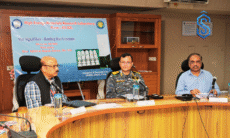
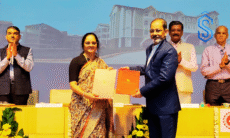
The inaugural session of NeXT-2026 was graced by the Chief Guest, Prof Dr Prateek Kishore, Director General, Armament & Combat Engineering (ACE), along with Prof Suresh Gosavi, Vice-Chancellor, Savitribai Phule University of Pune.
Prof. (Dr.) Prateek Kishore underscored the growing importance of high-performance computing, artificial intelligence, and simulation-driven methodologies in enabling precision-oriented development of future energetic materials.
Dr A P Dash, Director, HEMRL, emphasised the need for predictive modelling frameworks to enhance both performance parameters and safety characteristics of next-generation explosive formulations. Dr M B Talawar, Technology Director, HEMRL, briefed participants on the objectives and scope of the NeXT-2026 short-term course.
Also Read: PM Narendra Modi Engages with Indian AI Start-Ups Ahead of India AI Impact Summit 2026
NeXT-2026 Features Expert Lectures and Strategic Panel Discussion
The NeXT-2026 programme comprised eight expert lectures delivered by eminent scientists, academicians, and industry professionals.
The NeXT-2026 sessions covered a wide spectrum of topics, including molecular modelling, AI-assisted retrosynthesis, material behaviour under extreme thermo-mechanical conditions, and vulnerability assessment of energetic systems.
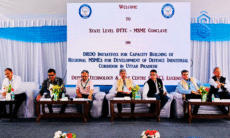
The course concluded with a panel discussion that enabled in-depth intellectual exchange and strategic brainstorming on collaborative research opportunities among DRDO, academia, and industry.
The NeXT-2026 event reaffirmed HEMRL-DRDO’s commitment to strengthening research capabilities and developing a robust roadmap for future advancements in high-energy materials science and technology.