
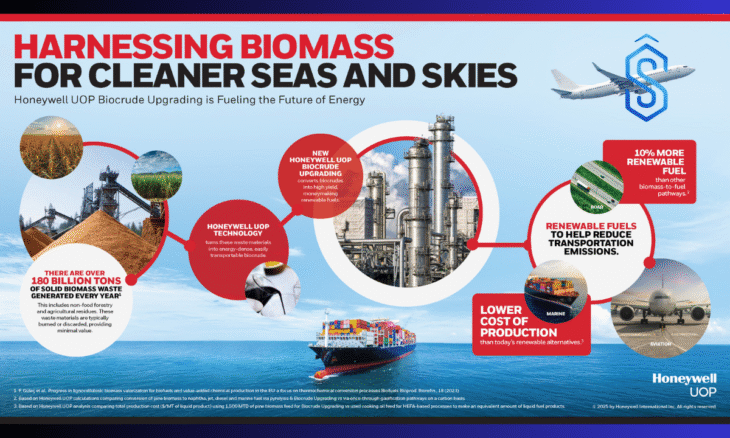
Bengaluru: Honeywell (NASDAQ: HON) has launched its innovative Honeywell Biocrude Upgrading Technology, a next-generation process that converts agricultural and forestry residues into high-quality, low-cost renewable fuels.
This breakthrough enables the production of lower-carbon marine fuel, sustainable aviation fuel (SAF), and gasoline from abundant and inexpensive biomass sources such as wood chips and crop residues.
Honeywell Biocrude Upgrading Technology: Enabling Cost-Effective Renewable Fuel Production
For shipping operators, these renewable “drop-in” fuels provide an immediate, lower-carbon alternative to conventional heavy fuel oil.
Also Read: Crude-to-Chemicals Innovation: Aramco, Honeywell, and KAUST Announce Strategic Collaboration
With greater energy density than most current biofuel options, Honeywell renewable marine fuel can extend a vessel’s range without requiring costly engine modifications or upgrades.
“Honeywell Biocrude Upgrading Technology addresses two major hurdles in renewable fuel production – cost and feedstock availability – by utilizing local agricultural and forest residues to create affordable lower-carbon fuels,” said Ranjit Kulkarni, Vice President and General Manager, Energy and Sustainability Solutions, Honeywell India.
“This innovation underscores Honeywell’s commitment to advancing India’s energy transition through scalable and sustainable solutions.”
Sustainable Conversion Process and Modular Plant Deployment
The new process allows agricultural waste to be converted into lower-carbon biocrude directly at feedstock collection sites, minimizing transportation costs.
This biocrude can then be refined at large facilities to produce marine fuel, SAF, or gasoline—offering performance levels comparable to traditional petroleum-based fuels.
Honeywell’s Biocrude Upgrading Technology can be deployed as a prefabricated modular plant, simplifying site construction, reducing risk, and accelerating implementation timelines.
Also Read: Honeywell 13MM Pressure Sensor to Boost Semiconductor Manufacturing Precision
Driving Decarbonization Across the Maritime Sector
The introduction of Honeywell Biocrude Upgrading Technology aligns with the maritime industry’s efforts to reduce its carbon footprint, driven by regulatory pressures and sustainability commitments. Historically, the sector has relied on heavy fuel oil, which contributes around 3% of global greenhouse gas emissions.
Expanding Honeywell’s Renewable Fuels Portfolio
For over a decade, Honeywell has been advancing renewable and alternative fuel technologies. The Biocrude Upgrading Technology complements its existing portfolio, including Ecofining, Ethanol to Jet, Fischer-Tropsch (FT) Unicracking, and UOP eFining technologies, which convert various feedstocks – including green hydrogen and carbon dioxide – into sustainable e-fuels.
Honeywell will showcase this innovation, along with other transformative solutions, at the Honeywell Growth Symposium 2025 scheduled for October 30–31, 2025, in Bengaluru, where industry leaders and technology experts will discuss the future of sustainable industrial growth.