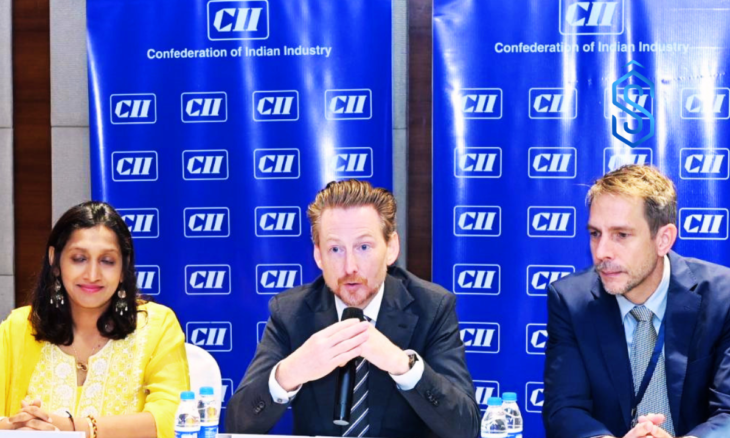
Pune: The India-Sweden Innovations Accelerator (ISIA) is opening opportunities for Swedish clean-tech and deep-tech companies to work with Indian businesses and startups, with Swedish space technology firm ECAPS exploring partnerships and localisation opportunities in India’s growing space ecosystem.
The company is participating in the ISIA programme for the third time and has been engaging with Indian government institutions, commercial spacecraft operators and companies involved in manufacturing spacecraft and satellite systems.
Willem De Geer, Vice President of Space Systems at ECAPS, said the company manufactures high-performance propulsion solutions for environments including space, high altitude and underwater applications.
He said ECAPS has progressed from exploratory discussions during its first India visit to more concrete conversations with potential Indian partners.
“We’re part of the ISIA program. And this is our third delegation trip here in India. The first one being very exploratory, now second and third trips becoming a bit more concrete, discussing with both partial government institutions, commercial spacecraft operators and large corporations who manufacture subsystems or even whole satellites here in India,” De Geer said.
The India-Sweden Innovations Accelerator is also helping Swedish companies explore opportunities to work with Indian startups and smaller businesses.
De Geer said ECAPS is engaging with both large corporations and startups, with the company looking at longer-term opportunities to localise its technology in India.
“We’re engaging with both large corporations and smaller startups,” he said.
According to De Geer, commercial space companies can operate on different timelines compared with institutional space programmes. While some commercial players may focus on getting their first product into orbit or expanding satellite fleets, ECAPS is also looking at opportunities to localise its technology within the Indian space ecosystem.
“Longer term where we want to localize here because it would make – within the Make in India framework and also for cost efficiency, having things supplying the ecosystem or utilizing the local ecosystem of space companies,” he said.
The India-Sweden Innovations Accelerator is designed to facilitate such market-entry and business collaborations by connecting Swedish technology providers with Indian companies and stakeholders.
The Swedish Energy Agency said the programme is intended to help innovative Swedish companies, particularly smaller businesses, overcome the challenges of entering the Indian market and reduce their time to market.
Nils Henoch, Senior Business Developer at the Swedish Energy Agency, said each market entry is different for every company and that ISIA serves as a platform to enable increased business and trade between Sweden and India.
The programme has been active in India since 2012 and will mark its 15th anniversary next year. Over the years, the India-Sweden Innovations Accelerator has introduced more than 80 companies to the Indian market and facilitated more than 250 pilot projects, while engaging around 1,500 companies and partners in India.
India-Sweden Trade Reaches $7.8 Billion
The expansion of technology and business collaboration comes as India and Sweden look to significantly increase bilateral trade. Erik Odar, Trade Commissioner at Business Sweden, said trade between the two countries reached $7.8 billion in 2025, compared with $2.9 billion in 2016.
The two countries have set an ambition to double bilateral trade within five years.
“And again, the objective now is to double that going forward within the next five years,” Odar said.
The India-Sweden Innovations Accelerator is one of the programmes being used to strengthen business and technology collaboration between the two countries.
Business Sweden and the Swedish Energy Agency are working with the Confederation of Indian Industry (CII) to support the expansion of these partnerships.
Odar said Sweden’s strengths include innovations connected to technology, energy and sustainability, while India offers opportunities for scaling these solutions.
Energy and related technologies are among the key focus areas for future cooperation, including energy efficiency, power generation and power grids. Manufacturing is another major area, with Swedish solution providers looking to engage with India’s rapidly growing manufacturing sector.
India-EU FTA Seen as Foundation for Trade Expansion
The discussions also highlighted the potential role of the India-EU free trade agreement in supporting future India-Sweden trade.
The Swedish delegation said it was too early to assess the impact of the agreement because it still needs to be implemented. However, Business Sweden said it expects the agreement to have a significant impact on trade between Sweden and India.
“We truly believe that the free trade agreement is going to have a huge impact on the trade between Sweden and India,” Odar said.
He added that the agreement is “very much the foundation” for achieving the ambition of doubling bilateral trade.
The India-Sweden Innovations Accelerator is also focused on creating practical business relationships rather than following a single technology-transfer model. Participants explained that collaborations can take different forms, including partnerships, licensing arrangements or local manufacturing, depending on the technology and the companies involved.
Pranati Shroff Munot, Core Committee Member, Indian Green Building Council (IGBC) Pune Chapter and Director, Sustain and Save, said the programme is based on business collaboration rather than a conventional model of simply selling technology to Indian companies.
Swedish Technologies Target Indian Market Opportunities
The India–Sweden Innovations Accelerator has facilitated the introduction of technologies across multiple areas, including energy, water management, waste management, clean mobility, energy efficiency and digital solutions.
The Pune workshop featured seven Swedish cleantech companies: C-Green, Drupps, ECAPS, Elonroad, Enclima Solutions, Holyvolt and PipeGuard. The participating companies presented solutions covering energy storage, resource efficiency, clean energy, water management, IoT and digital technologies, as well as clean mobility and green propulsion.
PipeGuard, another company participating in the India-Sweden Innovations Accelerator, is exploring opportunities around water pipeline leakage detection. Its representative said the company’s solution combines digital twin technology, hydraulic modelling and advanced sensors to identify leaks, while requiring relatively few sensors to begin a pilot.
The company said it was exploring a potential pilot area in India during its current visit. The representative also highlighted the scale of water losses from pipeline leakage, saying that “30 to 50% of the water is leaking out from the pipes” in many cases around the world, including Sweden.
ISIA Enters Next Phase of India-Sweden Collaboration
The India-Sweden Innovations Accelerator workshop in Pune brought together representatives from more than 60 Indian companies and seven Swedish cleantech companies. The event focused on technology adoption, business partnerships, pilot projects and long-term collaboration.
Erik Odar described the Pune session as the beginning of the next phase of the partnership. He said the process involves identifying areas where India has specific needs, matching those requirements with Swedish technologies and bringing selected solution providers to India to understand the local context.
“Today is very much about making introductions,” Odar said, adding that Swedish companies were in India to learn from the Indian context and understand what would be required to make a difference locally.
The India-Sweden Innovations Accelerator has so far introduced more than 80 advanced clean technologies to India, enabled more than 250 pilot and commercial projects, facilitated more than 50 industry partnerships and engaged more than 1,500 Indian stakeholders.
Also Read: Sarvam Signs MoU With HQ Integrated Defence Staff for Army, Navy, Air Force AI Projects